
Deep dental cleaning is not priced like a routine visit.
Many adults in Oakhurst first come to us after noticing early signs of gum disease, like bleeding when brushing or gums that feel tender.
How much is a deep dental cleaning depends entirely on how much infection is present and how many sections of the mouth require treatment.
Two patients can sit in the same chair and walk out with very different treatment plans.
That is why the better question is not “What’s the price?”
It’s “What determines the price?”
Key Takeaways
- Deep cleaning fees depend on what we find
- Quadrants and pocket depth drive the plan
- Insurance rules can shift your total
- A clear plan prevents surprise charges
How Much Is a Deep Dental Cleaning depends on what we find…
Deep cleaning fees depend on what we find because this is active treatment, not a cosmetic polish.
A deep dental cleaning, also called scaling and root planing, removes hardened buildup and bacteria below the gumline. That buildup is what keeps gums inflamed and prevents them from healing.
Most adults assume brushing harder will fix bleeding gums. It will not. Once infection settles under the gumline, a regular cleaning does not reach deep enough to solve the issue.
The cost reflects the clinical findings. The level of inflammation. The amount of buildup. The time required to clean the roots properly. It is based on what your gums need, not a standard number printed on a brochure.
Google Review
Quadrants and pocket depth drive the plan
Quadrants and pocket depth drive the plan because the mouth is treated in sections and measured in millimeters.
We divide the mouth into four quadrants. Some patients only need treatment in one or two areas. Others need care across the entire mouth.
Pocket depth tells us how far bacteria have traveled under the gums. Deeper pockets usually mean:
- More buildup to remove
- More time per quadrant
- More detailed root smoothing
- Closer follow-up after treatment
You can have no pain and still have deep pockets. That surprises people.
The treatment plan is built from those measurements. If only part of the mouth is involved, the fee reflects that. If all quadrants require therapy, the total reflects the additional time and precision.
Insurance rules can shift your total
Insurance rules can shift your total because deep cleaning is not classified as preventive care.
Most dental plans categorize deep cleaning as periodontal therapy. That means deductibles, percentages, and yearly maximums often apply differently than they do for routine cleanings.
We document the diagnosis carefully and explain how your specific plan is likely to process it. Before treatment begins, you know what insurance may contribute and what your projected portion looks like.
We do not estimate loosely and adjust later. Clear expectations matter.
A clear plan prevents surprise charges
A clear plan prevents surprise charges because confusion is what creates anxiety.
After your periodontal evaluation, we review:
- What we measured
- Why treatment is recommended
- Which quadrants need therapy
- How appointments will be scheduled
- What the projected total looks like
Nothing is added mid-treatment. Nothing changes without discussion.
Our practice at Ocean Dentistry Co. focuses on comprehensive care. We use modern diagnostic tools, digital imaging, and detailed measurements to guide decisions. Treatment recommendations are based on what is clinically present, not on assumptions.
Healthy gums support long-term stability, better function, and a more confident smile. Deep cleaning is often the step that restores that foundation.
What a deep cleaning usually includes
What a deep cleaning usually includes is more than just removing tartar.
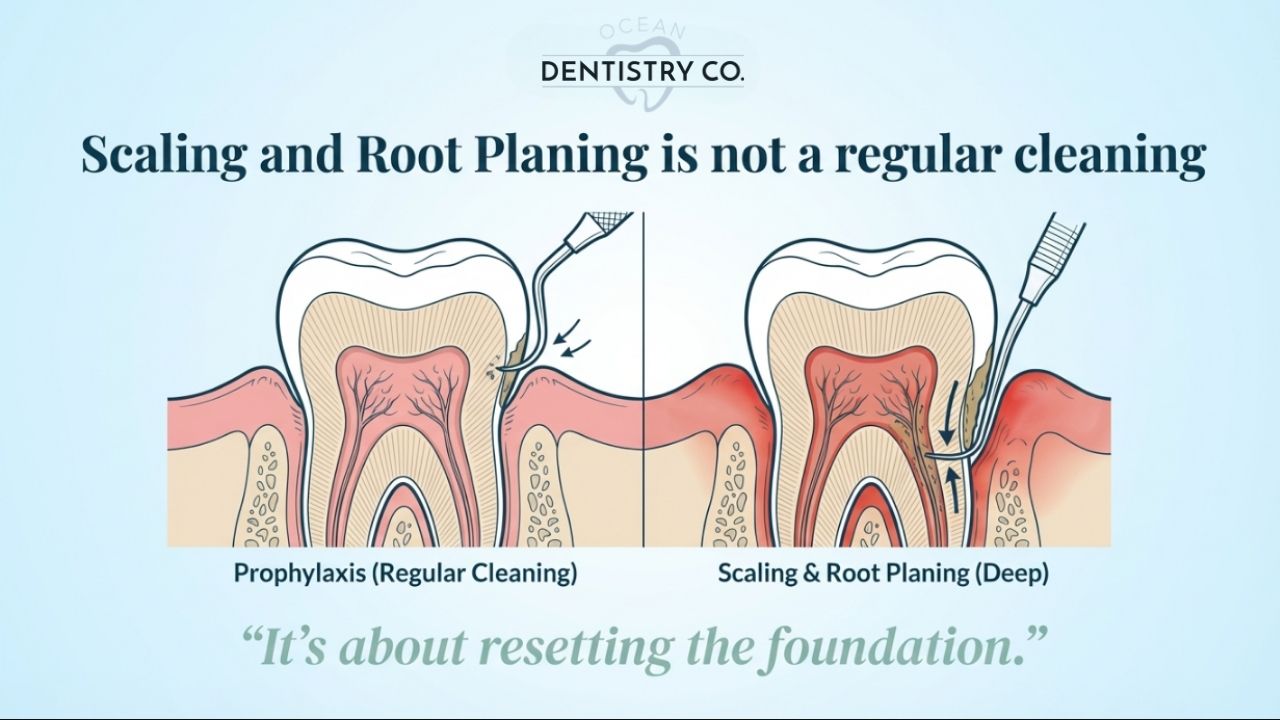
Treatment typically involves detailed periodontal measurements, careful instrumentation under the gumline, smoothing of root surfaces, and local anesthetic when needed for comfort. We move methodically through each area to reduce bacterial load and give the tissue the best chance to heal.
After treatment, we re-evaluate the gums. If inflammation improves and pocket depths reduce, we transition into periodontal maintenance to keep the infection controlled.
Deep cleaning is the reset. Maintenance is what protects the reset.
Cost factors we commonly see in Oakhurst
Cost factors we commonly see in Oakhurst are tied to severity and time.
The most common drivers include:
- Number of quadrants treated
- Depth of gum pockets
- Amount of hardened buildup below the gumline
- Level of inflammation present
- Recommended maintenance interval afterward
Each factor connects directly to healing. There are no mystery add-ons. The total reflects the clinical work required to stabilize the gums properly.
What happens if treatment is delayed
What happens if treatment is delayed is gradual progression.
Gum infection does not stay the same. Pockets can deepen. Bone support can slowly decrease. Over time, teeth can become less stable.
Many adults do not feel discomfort in the early stages. That is why measurements and imaging matter. Catching the problem early often means more controlled treatment and better long-term results.
Deep cleaning is often the point where we stop the cycle before it advances.
FAQs
Can deep cleaning help with chronic bad breath?
Yes. Persistent bad breath is often caused by bacteria trapped below the gumline. Removing that buildup during scaling and root planing frequently improves breathing noticeably once the gums begin to heal.
How do we know if a deep cleaning is really necessary?
We determine that through a periodontal exam. If pocket measurements show deeper spaces between the gums and teeth along with inflammation or bone changes, deep cleaning is recommended because routine cleaning will not correct the infection below the surface.
The diagnosis is based on measurable findings, not guesswork.
How many visits does deep cleaning usually take?
Deep cleaning is often completed over multiple visits because we treat the mouth in sections. The number of appointments depends on how many quadrants require therapy and how sensitive the gums are.
We structure visits to allow thorough treatment and proper healing.
Will the gums fully heal after deep cleaning?
In many cases, inflammation decreases and pocket depths improve significantly once bacteria are removed and proper maintenance begins. Healing depends on home care, follow-up visits, and overall health.
Deep cleaning creates the conditions for healing. Maintenance supports it long term.
Can the cost change after treatment starts?
No. Once we complete the evaluation and outline the treatment plan, the projected total is discussed in advance. Changes only occur if clinical findings change and those are always reviewed before proceeding.
Clarity comes first.
What are signs that we should schedule an evaluation?
Bleeding while brushing, persistent bad breath, gum tenderness, or gums that appear to be receding are common signs. Some adults experience no symptoms at all.
If you are unsure, a periodontal evaluation provides a clear answer and a defined next step.