
How Long Do Dental Veneers Last And What Actually Affects Them?
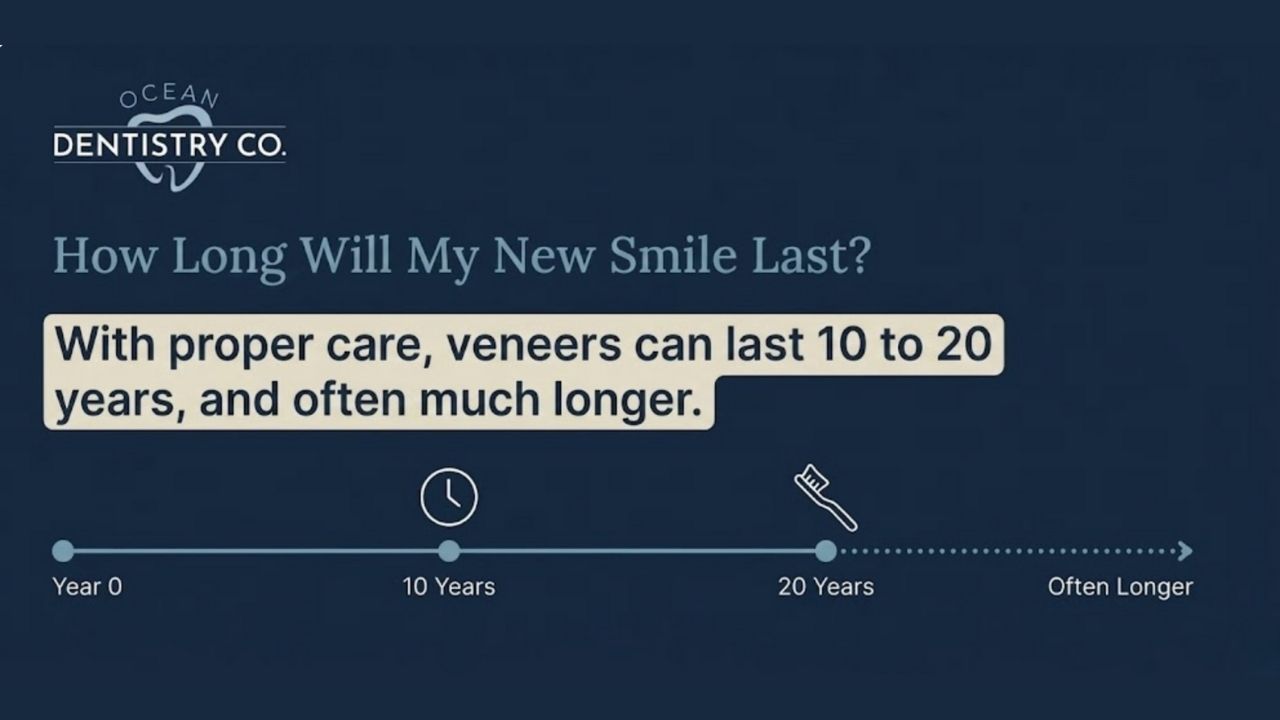
It’s a great question. We get asked that all the time. The dental veneer lifespan is anywhere from 10 to 20 years, depending on how well they are taken care of.
People think that if they get veneers, they don’t have to take care of their teeth, but it’s really important to understand that there’s still tooth structure underneath, and decay can still happen.
There are many factors that will determine the life of your dental veneers.
Key Takeaways
- Materials don’t replace planning
- Bite forces affect cosmetic longevity
- Not every smile qualifies for “no-prep”
- Conservative dentistry isn’t one-size-fits-all
- Repetition builds predictability
Different Types of Veneers and What Actually Matters
Different types of veneers matter because the material being used and how the tooth is prepared directly affect strength, aesthetics, and long-term success.
The best thing to do is obviously to do your own research, but just as important is finding a doctor who really does many of these cases and has a strong understanding of cosmetic dentistry.
To keep it simple, the differences between veneers come down to the material that’s being used. Certain materials are more aesthetic but weaker, while others are stronger but less aesthetic.
It really matters that the doctor understands which situation allows for which material and what’s better for that particular patient.
No-prep veneers are a technique where the tooth does not have to be prepared, but certain patients qualify for that particular procedure, and not every patient would be a candidate. You typically look for cases where the bite is proper, and the teeth are smaller, and we want to make them bigger.
Of course, if the teeth are already proportionate in size and we just want to make some changes, putting no-prep veneers on top of that is only going to make the teeth look bigger and bulkier.
Patient Review
After literally 15 years at another practice, I switched this year and could not be happier. Every single person who works there is friendly and professional. After the most thorough exam and cleaning I’ve had in years, I had a consultation with Dr. Gamburg about my smile. He knew exactly what I wanted to change and I decided to go for a transformation with veneers. I’m thrilled with the results. The team was amazing throughout the process, not just in terms of communication but in their genuine excitement for me. During the appointments, Dr. Gamburg and his crew were fantastic. I was in the chair for hours and they did everything possible to make me comfortable. I never thought I’d look forward to going to the dentist but I’m not exaggerating when I say that I smile when I get a notification from them. This office is special. Dawn M.
What to Know About Veneers, Crowns, Inlays, and Onlays
Crowns, veneers, inlays, and onlays are all different types of ceramic and porcelain restorations. The important thing is to shave the tooth down as little as possible to maintain as much tooth structure as we can.
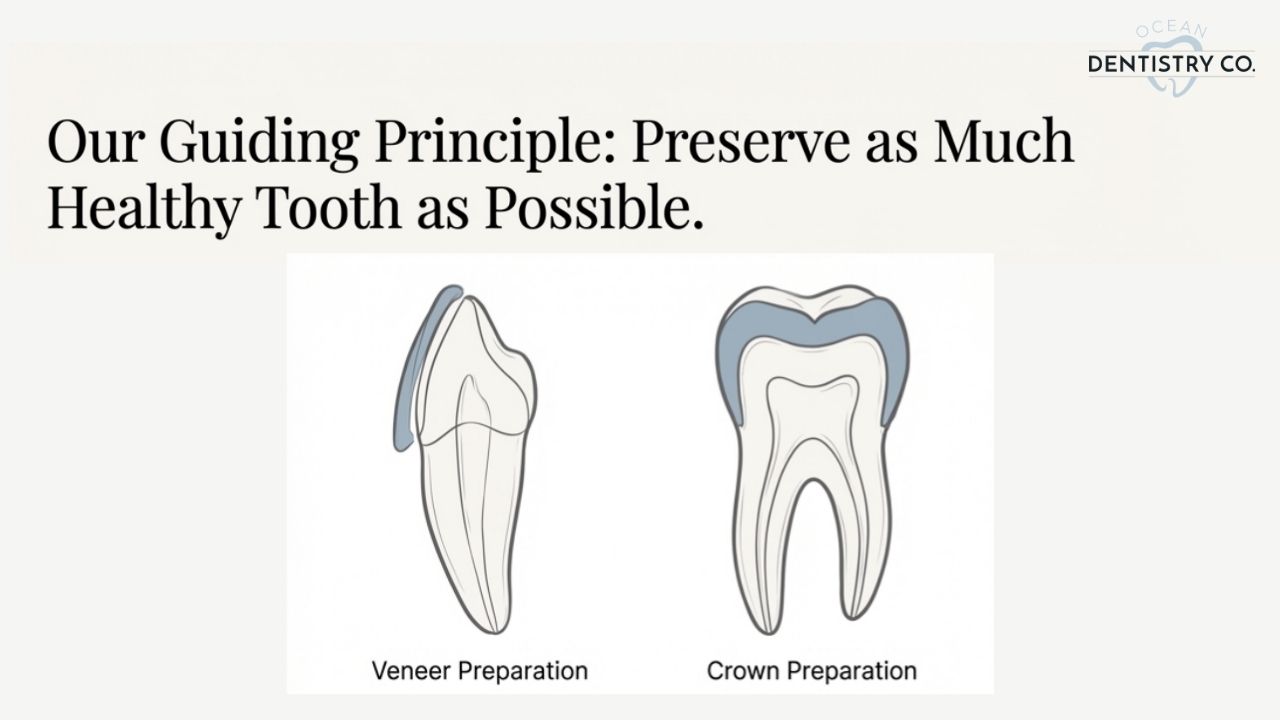
These restorations require different types of preparation. Some are more aggressive, and some are obviously a lot more conservative. The goal is always to keep the preparation as conservative as possible.
Some teeth don’t allow us to do that if there is a lot of decay, if there’s a big restoration, or if the bite doesn’t allow for it. In a well-planned case, as little tooth structure as possible should be taken away.
The goal is to achieve the result that we want, and whether it needs to be a crown or a veneer, at Ocean Dentistry Co. there is no difference in cost between the two. It’s really a matter of what’s proper for that particular case while preserving as much tooth structure as possible.
Cost, Insurance, and Affordability
In typical situations, insurance does not provide a huge benefit for cosmetic cases because they don’t deem them absolutely necessary.
There are cases where these restorations are needed, whether it’s a veneer or a crown, in order to restore the patient into a healthier bite or fix certain conditions. In those situations, insurance may cover some of the cost, but it’s not guaranteed and it varies depending on the case and how much the insurance company decides to contribute.
Insurance can be complicated, and it can really be a whole separate conversation about what it covers and what it doesn’t.
If insurance doesn’t cover treatment, payment plans are available. Treatment can also be scheduled in a way that takes care of the biggest problems first and works with the patient in terms of budget and time. Different types of financing are offered, both in-office and through third-party providers, with the goal of making dentistry as accessible as possible.
Why the Experience at Ocean Dentistry Co. Is Different
The experience at Ocean Dentistry Co. is different overall in the way patients are treated and in having great providers who offer all services under one roof.
Customer service is incredibly important. It matters that patients feel their time is valued, that they are important, and that they’re not just coming in and out and another number. That is what differentiates this practice from others in the area.
What differentiates Ocean Dentistry Co. in cosmetic dentistry is the amount of cases that have been done, the training involved, the lab that’s used, and the understanding required to achieve the best result. Somebody who has done more of these cases is naturally going to have a better understanding of how to achieve the best result possible than somebody who does them every so often.
Everything from the care and overall feel of the experience to the education of the doctors, the materials that are used, the level of training, and the number of cases completed allows the practice to say confidently that very good results can be achieved for patients.
In terms of experience, that equates to hundreds of veneer cases. While that doesn’t necessarily mean thousands of cases overall, individual veneer units number in the many thousands, since one case can involve anywhere from eight to twenty teeth depending on the situation.
Frequently Asked Questions About Dental Veneers
How can dental veneers last as long as possible?
Veneers typically last anywhere from 10 to 20 years depending on how well they’re taken care of. Veneers sit on top of the tooth, so there is still tooth structure underneath and decay can still happen.
How long veneers last depends on how well the patient takes care of their teeth and how their bite is set up, including the amount of wear that happens on the veneers.
When veneers are taken care of properly, they can last longer than 20 years, and when they’re not, they can fail sooner.
Do veneers fail because of the material or other factors?
Certain materials are more aesthetic but weaker, and certain materials are stronger but less aesthetic.
Longevity depends on understanding which material is appropriate for each situation, as well as how the bite is set up and how much wear is placed on the veneers over time.
Planning and experience play a major role in long-term success.
Are no-prep veneers always the best option?
No-prep veneers are a technique where the tooth does not have to be prepared, but not every patient would be a candidate.
You typically look for cases where the bite is proper and the teeth are smaller and we want to make them bigger.
If the teeth are already proportionate and only cosmetic changes are desired, no-prep veneers can make the teeth look bigger and bulkier.
How is it decided whether veneers, crowns, or another restoration is needed?
Crowns, veneers, inlays, and onlays are all different types of ceramic restorations, and the goal is always to preserve as much tooth structure as possible. Some situations allow for conservative preparation, and others don’t, especially when there is decay, a large restoration, or bite issues.
In a well-planned case, as little tooth structure as possible should be removed while still achieving the result that’s needed. Whether that means a crown or a veneer depends on what’s proper for that particular case.
Final Thoughts
Final thoughts on dental veneers come down to longevity, planning, and long-term health.
Veneers are an investment in long-term health, confidence, and comfort. When they’re planned correctly, placed thoughtfully, and cared for properly, they can last for decades and truly change the way you feel about your smile. Ocean Dentistry Co. is here to educate, build trust, and help patients make the right decision for their long-term oral health.
Ocean Dentistry Co.

Dr. Gamburg is a trusted family, cosmetic, restorative, and implant dentist in Ocean Township, NJ, serving patients at Ocean Dentistry Co. in Oakhurst. A Rutgers School of Dental Medicine graduate, Dr. Gamburg completed his General Practice Residency at Jersey Shore University Medical Center and advanced training in dental implants through the NYU College of Dentistry Postgraduate Implant Program.
Dedicated to providing exceptional dental care, Dr. Gamburg offers a full range of services, including preventive dentistry, smile makeovers, restorative treatments, dental surgery, and implant dentistry. He continues to expand his expertise through regular continuing education and active involvement in professional organizations, including the American Dental Association, the Academy of General Dentistry, and the New Jersey Dental Association.
Fluent in Hebrew and conversational in Russian and Spanish, Dr. Gamburg connects with patients from diverse backgrounds. Known for his warm approach and focus on patient comfort, he is committed to making every visit a positive experience. Whether you need routine care or advanced treatment, Dr. Gamburg and Ocean Dentistry Co. provide compassionate, high-quality dentistry for families in Oakhurst and the greater Jersey Shore community.