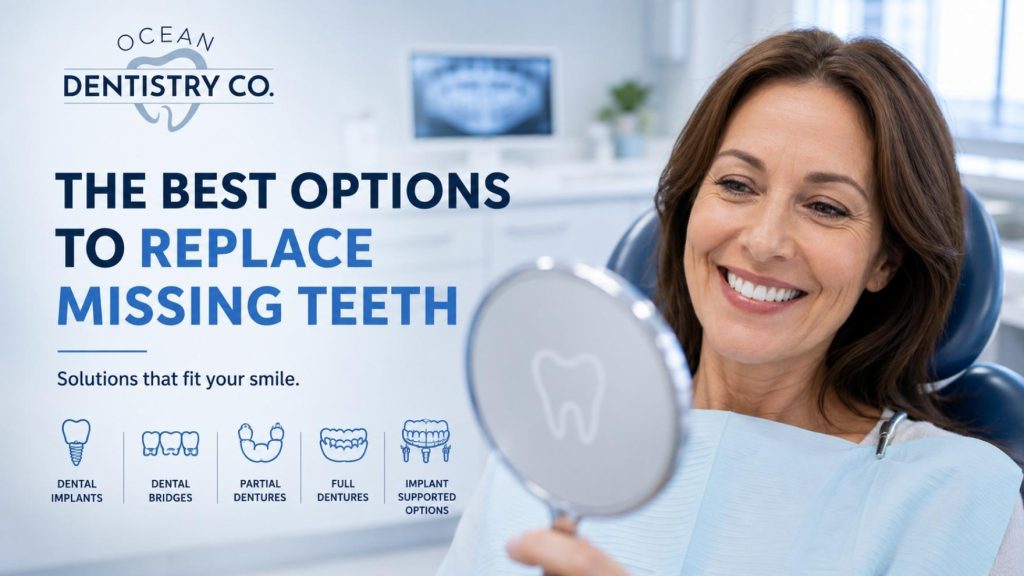
The best options to replace missing teeth are usually dental implants, dental bridges, partial dentures, full dentures, implant-supported dentures, and full-arch options like All-on-4. The best options will depend upon your bone health, gum health, budget, timeline, and how you want your teeth to feel day to day. At Ocean Dentistry Co. we walk through every option before recommending anything.
Key Takeaways
-
Implants are not your only option
Bridges, partials, dentures, and full-arch options may also work.
-
Bone health matters more than most think
Your jawbone can affect timing, cost, and implant candidacy.
-
Bridges can be faster than implants
A bridge may replace a tooth without surgery in some cases.
-
Partials deserve more credit
A partial denture can be a real solution, not a failure.
-
The best choice starts with a 3D exam
Imaging helps us see what is possible before you decide.
Missing a tooth can feel embarrassing, frustrating, or even overwhelming. But you are not alone. Around 178 million adults in the U.S. are missing at least one tooth, according to Cleveland Clinic.
You Have More Teeth Replacement Options Than You Think
Replacing missing teeth is not a one-size-fits-all decision. Some patients want the strongest long-term option. Some want something removable and affordable. Some are nervous about surgery. Some need a temporary tooth while they heal.
That is why a good tooth replacement conversation should include all of these:
- Dental implants.
- Dental bridges.
- Partial dentures.
- Full dentures.
- Implant-supported dentures.
- All-on-4 or full-arch implants.
- Temporary options, like a flipper or healing denture.
The American Dental Association lists implants, fixed bridges, and removable partial dentures as common tooth replacement options. You might be wondering, “Which one is best?”
The honest answer is this: the best option is the one that fits your health, your goals, and your budget without creating bigger problems later.
At Ocean Dentistry Co., we use digital X-rays, 3D imaging, and intraoral cameras to help patients understand what is happening in their mouth before making a decision.
Actual Patient Testimonial
Great experience at Ocean Dentistry Co. The staff is extremely professional and welcoming. I would highly recommend this practice to anyone looking for a positive dental experience! Kyli S.
Best Options to Replace Missing Teeth

Missing a tooth leaves you with more than one way to fill the gap. Dental implants, bridges, and dentures each replace a tooth differently, and the right choice depends on your bone health, your budget, and how permanent you want the result to be. Below is a closer look at dental implants, one of the most common questions patients ask about.
Dental Implants: A Better Natural Tooth Replacement Option
Dental implants are often considered a better, natural tooth replacement for missing teeth.
An implant is a small post placed in the jawbone. After it heals, it supports a crown, bridge, or denture. A crown is the visible tooth-shaped part you chew with. Many patients like implants because they do not come in and out. They are designed to function like a natural tooth. Implants may also help support the jawbone structure under the missing tooth area. That matters because bone can shrink after tooth loss.
But implants are not instant for every patient. Mayo Clinic notes that implant candidates need enough bone to support the implant, or they may need bone grafting first. They also need healthy oral tissues and must be able to commit to a process that can take several months.
An implant may be a good fit if you want a fixed tooth, have enough bone, want to avoid preparing nearby teeth, and are comfortable with the surgical process. It may not be the first choice if you want the fastest option, have major bone loss, smoke, have certain healing concerns, or need the lowest-cost solution.
Dental Bridges: A Reliable Fixed Option
A dental bridge replaces a missing tooth by using nearby teeth for support.
A traditional bridge usually has crowns on the teeth next to the space, with an artificial tooth in the middle. Cleveland Clinic explains that bridges can restore chewing function, improve appearance, and help oral health.
The biggest benefit is that a bridge is fixed. You do not remove it at night. It can also be faster than an implant because it usually does not require implant surgery or months of healing. But there is a tradeoff.
A traditional bridge often requires shaping the teeth next to the missing tooth. If those teeth already need crowns, that can make sense. If they are totally healthy, we need to talk carefully before choosing that route.
A bridge may be a good fit if the nearby teeth already need support, you want something fixed, you are not ready for implant surgery, or you want a faster timeline. It may not be ideal if the nearby teeth are strong and untouched, or if cleaning under the bridge would be difficult for you.
Partial Dentures: Affordable and Practical
A partial denture replaces one or several missing teeth and comes in and out. Some people feel nervous when they hear the word “partial.” They think it means they are choosing a lesser option. That is not how we look at it.
A partial can be a smart, practical way to replace missing teeth, especially if you are missing several teeth or need a lower-cost option. It can help you chew better, smile more comfortably, and avoid walking around with visible gaps.
Partials are removable, so they do not feel exactly like natural teeth. There is also an adjustment period. But for many patients, they are a legitimate solution.
A partial may be a good fit if you want a more affordable option, are missing several teeth, are not ready for surgery, or need something that can be changed later. It may not be ideal if you want a fixed tooth that never comes out.
Full Dentures vs. Implant-Supported Dentures
Full dentures replace a full upper arch, lower arch, or both. Traditional dentures rest on the gums. They are removable. They can restore your smile and help with chewing, but lower dentures can sometimes move more because the tongue and jaw muscles are active.
Implant-supported dentures use implants to help hold the denture in place. These are sometimes called snap-in dentures. The day-to-day difference can be big.
Traditional dentures are usually more affordable. Implant-supported dentures often feel more stable. They may help with chewing confidence and reduce movement. This does not mean everyone needs implants under their denture. It means we should talk about what you want your daily life to feel like.
All-on-4 and Full-Arch Implants
All-on-4 is a full-arch implant option for people who need to replace most or all teeth in an upper or lower arch.
Instead of replacing every tooth with its own implant, a full arch of teeth is supported by a smaller number of implants. For some patients, this can be life-changing. But it is not for everyone.
Full-arch implants require careful planning. We need to look at your bone, bite, gum health, medical history, and expectations. A 3D scan is important because we need to see the jaw clearly before deciding what is safe and realistic.
All-on-4 or full-arch treatment may be a good fit if you have many failing or missing teeth, struggle with loose dentures, want a more stable full-mouth option, and are healthy enough for implant treatment.
It may not be the best first step if only one tooth is missing, if your budget is limited, or if your mouth needs infection control before implants.
Beautiful dentistry requires patience. We never rush healing just to make a treatment sound faster.
Same-Day Teeth and Temporary Options For Replacing Missing Teeth
Same-day teeth can mean different things, so it is important to ask what is actually being promised.
Sometimes “same-day” means you leave with a temporary tooth or a temporary set of teeth. Sometimes it means an implant is placed the same day as an extraction. Sometimes it means a full-arch temporary bridge is attached on the day of surgery. Those are not all the same thing.
A temporary tooth can be very helpful while you heal. A flipper, temporary bridge, or healing denture may help you smile and function during the waiting period. But the final result often still takes time. Healing matters. Bone matters. Gum tissue matters. Rushing the process can create problems later.
At Ocean Dentistry Co., we explain what can be done right away and what needs time. That way, you are not surprised after treatment begins.
How Much Does A Tooth Replacement Cost in New Jersey?
Tooth replacement cost in New Jersey can vary a lot. A partial denture is usually one of the lower-cost options. A bridge is often in the middle. A single dental implant with the implant, abutment, and crown is usually a larger investment. Full-mouth implant options cost more because they involve more planning, materials, appointments, and surgery.
The exact number depends on your exam, X-rays, 3D imaging, bone health, gum health, number of missing teeth, and whether extractions or grafting are needed. This is where patients get frustrated. And honestly, we understand why.
It can be hard to compare quotes because one office may include imaging, the abutment, the crown, temporaries, or sedation, while another office may list those separately.
So instead of asking only, “How much is the implant?” ask:
- What is included?
- Is this for the implant only, or the full tooth?
- Will I need a bone graft?
- Is the temporary tooth included?
- How many visits are expected?
- What happens if the plan changes?
That conversation should be clear before you start.
How to Choose the Right Tooth Replacement Option
The right tooth replacement option starts with a simple decision framework. First, we look at your health. Are your gums healthy? Is there infection? Is there enough bone? Are the nearby teeth strong?
Then we look at your goal. Do you want fixed teeth? Are you okay with something removable? Is your main concern chewing, appearance, cost, or timing?
Then we look at your timeline. Do you need a front tooth replaced quickly? Are you willing to wait for implant healing? Do you need a temporary option? Then we look at your budget. We do not want you to feel pushed into something you are not comfortable with.
This is why we explain everything first. Dr. Gamburg’s approach is problem-solution based. Patients need to understand the issue in simple terms before choosing care, and pictures often help make that clear.
From the moment you walk in, the goal is to make the process feel different: calmer, clearer, and more respectful.
Tooth Replacement at Ocean Dentistry Co.
Our office offers restorative options, including dental implants, bridges, partial dentures, complete dentures, implant-supported dentures, and All-on-4 treatment under one roof. Your first step is not pressure. It is a conversation.
We examine your mouth, take the needed images, talk about your goals, and explain what each option would mean for you. If something is not a good fit, we tell you. If there is a simpler option, we talk about that too.
No judgments. No high-pressure selling. Just clear information, good planning, and a team that wants you to feel confident in the care you receive.
FAQs About Replacing Missing Teeth
Is a dental implant always the best option?
No. A dental implant may be the best option for many patients, but not every patient. Your bone health, gum health, budget, timeline, and medical history all matter.
What is the fastest way to replace a missing tooth?
A temporary tooth, partial denture, or bridge may be faster than an implant in some cases. But speed should not be the only goal. The replacement also needs to be healthy and stable.
Can I get a tooth replaced the same day it is removed?
Sometimes, yes. But it depends on infection, bone quality, gum tissue, and the type of replacement. Some patients can receive a temporary tooth the same day, while the final tooth comes later.
What is better, a bridge or an implant?
An implant replaces the tooth root area and does not rely on nearby teeth. A bridge can be faster and may be a great option when nearby teeth already need crowns. The better choice depends on your mouth.
Are partial dentures worth it?
Yes, for the right patient. A partial denture can be an affordable and helpful way to replace missing teeth, especially when several teeth are missing or surgery is not the right choice.
What happens if I wait too long?
Waiting can allow teeth to shift and bone to shrink in the missing tooth area. That may make future treatment more involved. A consultation can help you understand your timing.
How do I know which option is right for me?
You need an exam, X-rays, and often 3D imaging, which can be done right here in our beautiful office in Oakhurst, NJ. Once we can see your bone, gums, bite, and nearby teeth, we can explain your realistic options clearly.
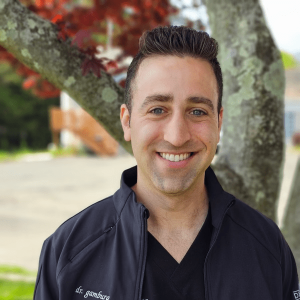
Dr. Gamburg is a trusted family, cosmetic, restorative, and implant dentist in Ocean Township, NJ, serving patients at Ocean Dentistry Co. in Oakhurst. A Rutgers School of Dental Medicine graduate, Dr. Gamburg completed his General Practice Residency at Jersey Shore University Medical Center and advanced training in dental implants through the NYU College of Dentistry Postgraduate Implant Program.
Dedicated to providing exceptional dental care, Dr. Gamburg offers a full range of services, including preventive dentistry, smile makeovers, restorative treatments, dental surgery, and implant dentistry. He continues to expand his expertise through regular continuing education and active involvement in professional organizations, including the American Dental Association, the Academy of General Dentistry, and the New Jersey Dental Association.
Fluent in Hebrew and conversational in Russian and Spanish, Dr. Gamburg connects with patients from diverse backgrounds. Known for his warm approach and focus on patient comfort, he is committed to making every visit a positive experience. Whether you need routine care or advanced treatment, Dr. Gamburg and Ocean Dentistry Co. provide compassionate, high-quality dentistry for families in Oakhurst and the greater Jersey Shore community.