
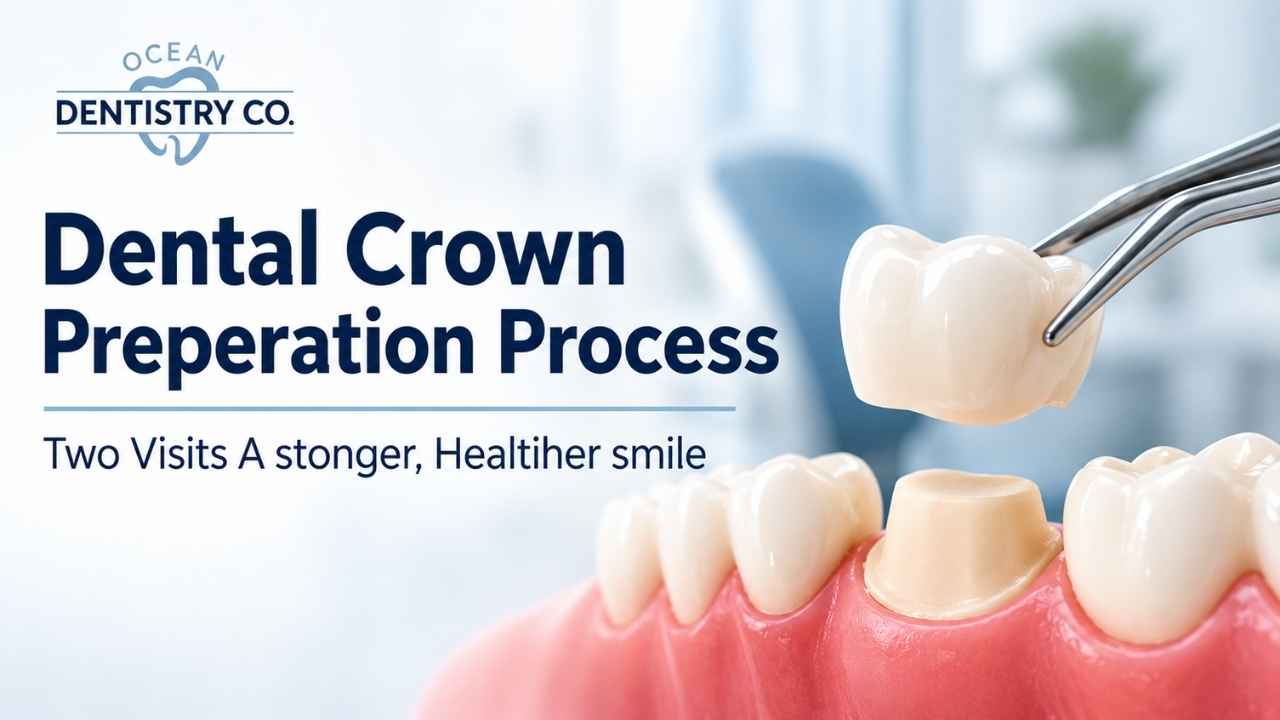
Dental crown preparation follows 6 main steps. Through the dental crown preparation process, the tooth is assessed, numbed, cleared of decay, shaped, rebuilt where needed, recorded for the lab, and covered with a temporary crown. In the next phase, the permanent crown is fitted, confirmed with an X-ray, and cemented into place.
Plenty of people wait on that first visit. A rough appointment years ago, a gag reflex that makes everything harder, an anesthetic that never fully took. Sometimes it’s just not knowing what you’re agreeing to. Waiting rarely makes the tooth easier to fix.
Key Takeaways
- Dental crown preparation follows six main steps.
At Ocean Dentistry Co., the tooth is numbed, cleaned, rebuilt if needed, shaped, scanned, and protected with a temporary crown. - Your crown shade is selected before shaping.
The shade is recorded early because a tooth can dry out and appear lighter during a long appointment. - Old fillings are removed before rebuilding begins.
Removing decay and old material shows how much healthy tooth remains and whether a core buildup is needed. - The tooth is shaped and digitally scanned.
Shaping creates room for the crown, while the scan records the prepared tooth, nearby teeth, and bite. - A temporary crown protects the prepared tooth.
It covers the tooth while the dental lab makes the permanent crown, usually over the next two to three weeks. - The final crown is checked before cementing.
The dentist confirms the edges, contact, appearance, and bite before securing it.
The good news is that a tooth needing a crown is a tooth still worth saving, and the process is more predictable than it feels from the outside. Ocean Dentistry Co. plans around the parts people dread, from pause signals to sedation. Here’s every step, in order.
What Is Dental Crown Preparation?
Dental crown preparation begins by getting the base clean, stable, and shaped with enough room for the new cover to fit without changing your bite. Decay and failed filling material come out first. The tooth may need a repair after that. You can read more about Ocean Dentistry Co.’s dental crowns and bridges.
Shaping is only part of the job. An old restoration can hide a crack or decay close to the nerve. When that happens, the plan may change. The dentist can show you what was found and explain the next step before the crown is finished.
The aim is to stop the damage and keep a tooth that can still be restored working.
What Happens Before Your Crown Preparation Begins?
Before crown preparation begins, nothing gets shaped until the dentist confirms a crown is the right answer for this particular tooth. That assessment covers several things, and it happens while the tooth is still in its original condition.
The dentist examines the tooth and takes X-rays to check the root and the surrounding bone. An intraoral photo of the tooth is taken for your insurance. A bite analysis follows, so the new crown will work with the way your teeth actually meet.
Then two things happen that patients rarely expect. The shade of your permanent crown is selected while the tooth is still untouched, because teeth can shift in color during a long appointment and matching early gives a truer result. A preliminary impression is also taken with a triple tray and alginate. That impression isn’t for the permanent crown. It’s the mold Ocean Dentistry Co. uses to build the temporary you’ll wear home.
Why not place one more filling? Sometimes there is not enough strong tooth around the existing filling to trust. A crown surrounds the thin walls that remain and helps them handle the force of biting.
Tell the team if you are anxious, hard to numb, or prone to gagging. A difficult dental visit in the past matters too. Ocean Dentistry Co. offers sedation dentistry options. The right option depends on your health and the work being done.
6 Steps For Dental Crown Preparation at Ocean Dentistry Co.
The step-by-step dental crown preparation process has six main parts: numbing, cleaning, shaping, rebuilding when necessary, taking the final impression, and protecting the tooth. A front tooth and a back tooth will not need identical work. Neither will a small fracture and a deep one.
Step 1: The Tooth Is Numbed, and You Get Comfortable
Local anesthetic goes in first, numbing the tooth and the gum around it. The team checks the area before moving on. You can also agree on a hand signal if you want a break.
Numb does not mean silent. You may hear the handpiece and notice water, vibration, or pressure. A sharp feeling is different. Use your hand signal so the dentist can pause and check the area.
Step 2: Decay and Old Filling Material Are Removed
With the area numb, any existing decay or damaged tooth structure comes out. This matters because a new crown should not seal a known problem underneath it.
Now the dentist can see the tooth without the old material in the way. If a crack runs farther than expected, or decay reaches the nerve, the dentist may recommend root canal treatment before completing the crown.
A surprise under a filling does not mean the tooth is lost. It gives the dentist the information needed to choose a treatment that can hold up.
Step 3: The Tooth Is Carefully Shaped for the Crown
Next the dentist reshapes and contours the tooth to create a stable foundation for the crown. Shaping makes room for the crown material and forms the edge where crown and tooth will meet.
There is no single measurement for every crown. A front tooth, a back tooth, and a badly broken tooth start in different places. The dentist creates the space needed for the chosen material and keeps healthy structure when possible.
Step 4: The Tooth Is Rebuilt Where It Needs Support
When decay was extensive or part of the tooth is missing, a buildup is placed to give the crown a stable base. What remains of the tooth determines whether this step is needed at all.
One tooth may need a small repair. Another may need more. The buildup is matched to the damage so the crown has a dependable place to sit.
Step 5: An Impression Records the Prepared Tooth
An impression of the prepared tooth is taken next, either with traditional materials or with digital scanning technology. This one is different from the preliminary impression at the start. It records the finished preparation, its neighbors, and how your teeth come together.
If impression trays make you gag, say so before this step rather than during it. The team can adjust the approach and give you a moment to settle.
The impression and the dentist’s design notes then go to the dental lab, which has everything needed to build the crown.
Step 6: A Temporary Crown Protects the Prepared Tooth
The final preparation step protects the tooth while the lab makes the permanent crown. Using the preliminary impression taken earlier, the team fabricates a temporary crown and seats it over the prepared tooth with temporary cement. It also helps keep the space from changing.
The temporary may feel different from the final crown. That is normal for a short-term cover. Its job is to protect the tooth until the next visit.
What Does Dental Crown Preparation Feel Like?
Dental crown preparation is a straightforward process once the tooth is fully numb. You may hear sounds and notice spray, pressure, or vibration. If anything feels sharp, raise your hand. There is no reason to wait it out.
The gum or tooth may be mildly tender when the anesthetic fades. Follow the directions from the office and notice whether the soreness is easing. Pain that keeps getting stronger deserves a call.
Speaking up gives the team a chance to make the appointment more manageable right away.
What Happens After the Tooth Is Prepared?
After the tooth is prepared, the impression and the dentist’s notes go straight to the dental lab. Before you leave, you’ll get instructions for the temporary and an idea of what to expect while you wait.
The lab works on the shape, side contacts, shade, and biting surface. Until it is ready, the temporary keeps the tooth covered.
You leave protected, and the final crown is already underway.
How Do You Care for a Temporary Crown?
Caring for a temporary crown comes down to keeping it clean without testing the short-term cement holding it in place. Follow the directions Ocean Dentistry Co. gives you, along with these usual precautions:
- Wait for the numbness to wear off before eating. This helps you avoid biting your cheek or tongue.
- Skip sticky foods and anything hard enough to lift or crack the temporary.
- Use the other side for chewing when that is comfortable.
- Brush gently around the area.
- Move floss down between the teeth, then pull it through the side rather than back up.
- Keep a Water-pik away from the area while the temporary is in place.
- If the temporary loosens, breaks, or comes off, call the office.
A few careful habits can protect the tooth and keep the final visit on schedule.
What Happens at the Final Crown Appointment?
At the final crown appointment, your temporary comes off and the new crown goes in for a test fit. The dentist checks its edges, the contact with nearby teeth, the bite, the shape, and the shade, and makes any adjustments needed for the fit and alignment.
Say something if one spot hits before the rest of your teeth. It may need only a small adjustment. Once the fit and bite are confirmed clinically and with an X-ray, the crown is bonded or cemented into place. The dentist checks your bite once more.
It may feel new at first. The goal is for it to settle into everyday chewing and stop drawing your attention.
When Should You Call Ocean Dentistry Co. After Crown Preparation?
After crown preparation, call Ocean Dentistry Co. if the temporary loosens, your bite feels uneven, swelling gets worse, or pain keeps building. Call about a symptom you cannot make sense of too. You do not have to name the problem before asking for help.
Do not use household glue. Save the temporary if you have it and avoid hard chewing on the tooth. The team can tell you what to do next.
How Ocean Dentistry Co. Makes Crown Treatment More Comfortable
Ocean Dentistry Co. makes crown treatment more comfortable through small choices along the way. The plan gets explained first. The numbness is checked before any shaping starts. The shade is matched early so you aren’t sitting through an extra step later. If fear or a strong gag reflex has kept you away, ask about sedation before the visit.
Comfort is not one big feature. It is the small stuff: time to get numb, permission to pause, and knowing what the dentist is doing before you hear the next instrument.
Ask what comes next. Request a pause when you need one. Staying involved can make the next step easier to face.
FAQs About Dental Crown Preparation
Do you really need a crown?
This answer about do you really need a crown comes directly from one of our own dentists. You usually need a crown when the filling is taking up so much of the tooth that the tooth itself is at risk of fracturing. It’s a valid question, because most of the time people say they want to have another filling. They had a filling there before; it was totally fine, so why can’t they just get that again?
Most of the time when you have these really big fillings that take up a big portion of the tooth, it puts the tooth at risk for fracturing, because there ends up being more filling material than tooth. If that were to break, you’re putting the tooth at risk. From there, you may need a crown in the future, or a root canal and a crown, or you can lose the tooth entirely.
Fracture lines are another reason people are recommended crowns. Patients will say they don’t have any pain on that tooth, and we can show them pictures of these deep crack lines. We can’t even tell for sure how deep the crack lines run until we clean everything out. Strengthening the tooth as a whole takes the risk of fracturing out of the picture.
Then the question is whether it will happen tomorrow, or whether you can wait, because the tooth has been fine all this time. The honest answer is I don’t really know. I can’t play God. I can only tell you what I see right now, and I’m seeing fracture lines and a very thin layer of tooth, and my concern is that it fractures. If you want to play it safe and eat nothing but noodles for a while, that would help. I’d typically recommend doing it sooner rather than later, because that’s always better than having to lose a tooth.
It’s not a big procedure. It’s a little bit longer than a typical filling, and that’s only because we clean the tooth out, take all the decay out, and then build the tooth back up with material once everything is cleaned
How Long Does a Dental Crown Preparation Appointment Take?
There is no single appointment length for every crown preparation. A large old filling or deep decay can add time. So can a buildup. Once Ocean Dentistry Co. reviews your treatment plan, the office can give you a useful estimate and reserve enough time.
Is Dental Crown Preparation Painful?
The tooth is normally numbed with local anesthetic before crown preparation. You may still notice pressure or vibration. A sharp feeling is your cue to raise a hand. The dentist can stop and help.
Why Is My Crown Shade Chosen Before the Tooth Is Prepared?
The shade is selected early because teeth can change color during a long appointment. Matching while the tooth is still in its original condition gives the lab a truer target. It is a small scheduling detail that affects how well the finished crown blends in.
How Much of My Tooth Has to Be Removed for a Crown?
Ask about your own tooth because one measurement would be misleading. The crown material needs room. The tooth’s location, the damage, and the healthy structure that remains also matter. The dentist balances those details instead of removing the same amount from everyone.
Will I Always Need a Temporary Crown?
You will usually wear a temporary while a lab makes the permanent crown. It is built from the preliminary impression taken before your tooth was prepared. If a temporary is used, the team will show you how to protect it.
Can I Eat Normally With a Temporary Crown?
Yes, you can usually eat once the numbness is gone. Caramel and other sticky foods can pull the temporary loose. Ice or hard candy can crack it. Easier foods and the other side of your mouth can help you get through the wait, and a Water-pik should stay away from that area entirely.
What If the Dentist Finds That I Need a Root Canal?
A needed root canal usually means the nerve is inflamed, infected, or too damaged to leave untreated beneath a crown. The root canal treats the problem inside. The crown can then protect the outside. The route has changed, but the tooth may still be saved.
Why Is an X-ray Taken Before the Crown Is Cemented?
The X-ray confirms the permanent crown is seated correctly before anything becomes permanent. The dentist checks the fit and bite clinically first, then verifies the margin on the image. Cementation follows once both checks look right.
What If I Am Nervous About Dental Crown Preparation?
If crown preparation makes you nervous, tell Ocean Dentistry Co. when you schedule. Remind the team when you arrive. Ask for a pause signal and a numbness check. Discuss sedation early so the team has time to review your health and plan safely.
You do not have to conquer every dental fear before protecting this tooth. You need a team that listens and one first step you can manage. From there, a comfortable and useful tooth is still within reach.
What Makes the Crown Preparation Experience at Ocean Dentistry Co. Feel Less Stressful?
The crown preparation experience at Ocean Dentistry Co. is designed to feel less stressful by keeping you informed and involved from the beginning. Before the tooth is shaped, the dentist evaluates the tooth, reviews X-rays, checks your bite, and explains why a crown is being recommended.
That matters because not knowing what is happening can make a dental appointment feel harder than the treatment itself. Ocean Dentistry Co. focuses on clear explanations, patient education, and helping you understand the problem and the solution in simple terms before moving forward.
The goal is for you to leave feeling confident about the care you received rather than feeling like treatment was simply done to you.

Dr. Gamburg is a trusted family, cosmetic, restorative, and implant dentist in Ocean Township, NJ, serving patients at Ocean Dentistry Co. in Oakhurst. A Rutgers School of Dental Medicine graduate, Dr. Gamburg completed his General Practice Residency at Jersey Shore University Medical Center and advanced training in dental implants through the NYU College of Dentistry Postgraduate Implant Program.
Dedicated to providing exceptional dental care, Dr. Gamburg offers a full range of services, including preventive dentistry, smile makeovers, restorative treatments, dental surgery, and implant dentistry. He continues to expand his expertise through regular continuing education and active involvement in professional organizations, including the American Dental Association, the Academy of General Dentistry, and the New Jersey Dental Association.
Fluent in Hebrew and conversational in Russian and Spanish, Dr. Gamburg connects with patients from diverse backgrounds. Known for his warm approach and focus on patient comfort, he is committed to making every visit a positive experience. Whether you need routine care or advanced treatment, Dr. Gamburg and Ocean Dentistry Co. provide compassionate, high-quality dentistry for families in Oakhurst and the greater Jersey Shore community.