
What Is An Infected Tooth Under a Crown?
Key Takeaways
- Antibiotics are usually temporary
Antibiotics may help keep a dental infection from spreading for a short time, but they do not fix the source. The source still has to be treated. - Pain is not always the warning sign
Many times, you will not have pain with an infection under a crown, especially if the tooth already had a root canal and the nerve is dead. - Saving the tooth comes first when possible
If the tooth can still be saved, treatment may involve cleaning out the infected nerve space or treating a gum infection around the tooth. - Extraction may be needed if the tooth is poor
If the tooth is fractured, broken, or in a poor situation, taking out the tooth may be the healthier choice. - Bone grafting can protect future options
Bone grafting may help support better healing and give you better options later for an implant, bridge, or denture.
An infected tooth under a crown usually means bacteria have reached the tooth, gum, or bone around the crowned tooth. The first step is not guessing. The first step is to come into the office, find the source of the tooth infection, and treat it.
Sometimes the tooth can be saved with nerve therapy, often called a root canal. Sometimes the infection comes from the gums or bone. And if the tooth is fractured, broken, or no longer worth saving, it may need to be removed and replaced.
At Ocean Dentistry Co. in Oakhurst, NJ, our goal is simple. We try to save the tooth every time it makes sense and it is a good option for the patient. When it does not, we focus on getting the infection out, helping the area heal, and getting you back to functioning comfortably.
How does a dentist take care of an infected tooth that’s under a crown?
Taking care of an infected tooth under a crown starts with finding out where the infection is coming from.
The first step is to come into the office and see what the source of the infection is. That matters because not every infection under a crown is the same. It may be inside the tooth. It may be around the gum. It may involve bone loss around the tooth.
If the infection is inside the tooth, the treatment may involve nerve therapy. Most patients know this as a root canal. A root canal removes infected or inflamed tissue inside the tooth, then cleans and seals the canal space. The American Association of Endodontists explains that root canal treatment is used when there is inflammation or infection in the roots of a tooth.
If the infection is from the gums or bone around the tooth, the treatment may be different. This type of gum infection or bone loss infection, also called a periodontal infection, may involve deep cleaning or antibiotic medication placed in the area around the tooth.
The main point is this. We do not want to just calm the symptoms. We want to know what is causing the problem.
Actual Patient Testimonial
I had a dental emergency whilst on vacation . This Dentist was amazing. Very thorough and professional , they got me out of severe pain and infection and resolved the situation to the highest standard.Highly recommend. Stuart H.
Can I just take an antibiotic, and will that make the infection go away?
Taking antibiotics alone usually will not make an infected crowned tooth fully go away.
This is one of the most common questions patients ask. An antibiotic prevents the infection from spreading further temporarily while a patient is taking medication, this is not realistic to keep someone on antibiotics forever or for an extended period of time. The source has to be treated.
That is also in line with the American Dental Association’s guidance on dental pain and swelling. The ADA guideline focuses on definitive dental treatment, such as root canal treatment, drainage, or other dental care, rather than relying on antibiotics when dental treatment is available.
You might be wondering why antibiotics can help for a few days, but the problem comes back.
It is because the infection still has a place to live. If bacteria are inside the tooth, under the crown, around a failed root canal, or in the bone, medication may reduce the spread for a short time. But it does not clean out the tooth, repair a fracture, or rebuild lost bone.
That is why the visit matters. We need to look, test, and often take imaging so we can make the right call.
What if the infected tooth under a crown has bone loss?
An infected tooth under a crown with bone loss needs a closer look because the tooth may or may not be worth saving.
If the tooth is “not in a situation that is worth saving,” or if trying to save it would be a guess, then the tooth may need to come out and be replaced with an implant.
That does not mean every infected crowned tooth with bone loss needs to be extracted.
It means the dentist has to look at the full picture. How much bone is left? Is the tooth fractured? Has the infection grown? Is the crown leaking? Did the tooth already have a root canal? Is the area close to the sinus or another important structure?
At Ocean Dentistry Co., 3D imaging can be helpful. The practice offers 3D imaging for precise treatment planning, along with root canal therapy, dental implants, oral surgery, and periodontal care under one roof.
If the tooth still has a good long-term outlook, saving it may make sense.
If the prognosis is questionable or poor, removing the tooth may prevent a bigger problem later.
Why can an infected tooth under a crown have no pain?
An infected tooth under a crown can have no pain because the nerve may already be dead or removed.
This surprises people. They think, “If I had an infection, wouldn’t I feel it?” Not always.
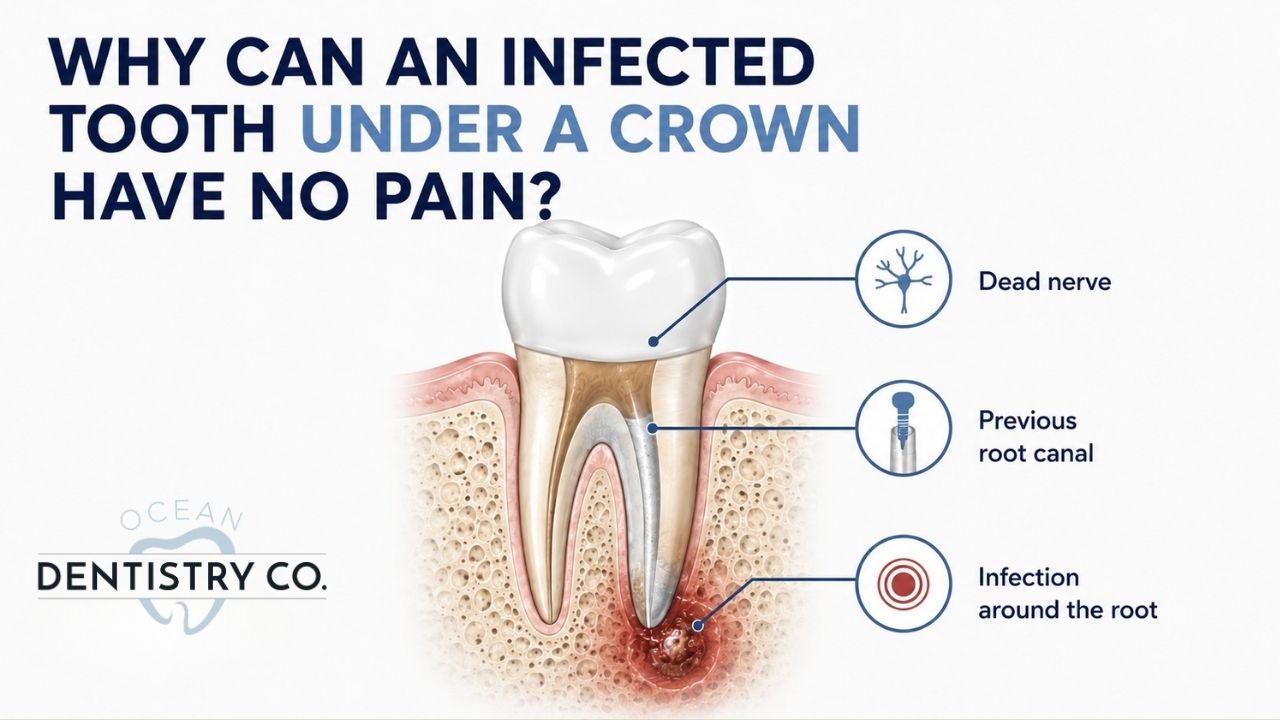
Many times, you will not have any pain when you have an infection because if the tooth is already a root canal, the nerve is dead.” It may start to hurt when the infection presses on other structures, such as other teeth, sinuses, or nerves in the jaw. That is why waiting can be risky.
If there is an infection and the tooth cannot be saved, letting it get bigger may turn a one-tooth problem into a multiple-tooth problem. If you wait because it does not hurt, the infection may keep growing.
This is the kind of problem we want to catch early.
Not because we want to rush treatment. We never rush healing. But we also do not want an infection quietly causing more damage while you feel fine.
When do you need a bone graft for an infected tooth under a crown, and how does that work?
A bone graft may be needed when an infected tooth is removed, and we want to preserve or rebuild the bone in that area.
In our practice, we recommend bone grafting almost every socket. The reason is that after a tooth is removed, the bone can collapse into the empty space as it heals. A graft helps support the area and can give the patient better options later.
Bone matters in tooth replacement. The currency we work with in dentistry, in terms of replacement, is bone. More bone may help with implant placement. It may also help if the patient chooses a bridge or denture. A wider ridge can mean less food getting trapped and better support for the future restoration.
In many cases, the tooth can be removed, the infection cleaned, the bone graft placed, and sometimes the implant placed the same day.
Not every case is a candidate. It depends on the amount of healthy bone left and whether the implant can be stable at the time of surgery.
Do you need to wait before you do an implant if you have an infected tooth under a crown?
You may need to wait before placing an implant, but not always.
If the tooth is removed and the implant is not placed the same day, there is usually a waiting period of three to four months for the bone to mature before placing the implant.
But many times, the implant can be placed at the same time as the extraction.
That means going through one healing process instead of two. If there is adequate bone remaining, we may be able to remove the tooth, clean out the infection, place the implant, graft around the implant, and let the area heal all at once.
It depends on the situation. It depends on the amount of good bone around the infection. It also depends on our surgeon’s judgment and whether there is enough good bone to stabilize the implant.
Beautiful dentistry requires patience. Sometimes, same-day treatment is the better path. Sometimes waiting gives the body a better chance to heal. The right answer comes from the exam and imaging.
If you have an infected tooth, is a tooth extraction painful?
If you have an infected tooth removed, you should not feel pain during the procedure.
During the procedure, we make sure that we numb the area enough so it’s pain-free. If needed, we have the option for sedation dentistry. That is an important option for anxious patients.
After the procedure, healing varies from person to person. Most patients have soreness or discomfort for 24 to 48 hours and are usually able to resume normal activities the next day. Some people feel very little. Some take longer to heal.
A lot depends on the size of the infection and how much work has to be done in the area.
Bigger infections can mean more healing time and more discomfort. But during the actual extraction, the goal is comfort, control, and making sure you are numb.
From the moment you walk in, the goal is to make the process feel clear and manageable. Fear is common. A bad past experience is common. But this should not feel like being rushed through something you do not understand.
Treatment for an infected tooth under a crown in Oakhurst, NJ
Treatment for an infected tooth under a crown starts with a careful exam, imaging, and a clear conversation about your options.
Ocean Dentistry Co. serves Ocean Township, Oakhurst, Monmouth County, and nearby Jersey Shore communities. Our office provides emergency dentistry, infection management, crowns, root canal therapy, implants, oral surgery, and gum care.
That matters because this type of problem may need more than one skill set.
Sometimes it is root canal treatment. Sometimes it is gum treatment. Sometimes it is extraction, bone grafting, and implant planning. Having those options in one dental home can make the process easier. The goal is not to scare you into treatment.
The goal is to educate you, show you what is happening, and help you understand what makes sense. We try to break things down into simple terms and use a problem-solution approach so patients understand the issue clearly. It’s about staying healthy.
FAQs About an Infected Tooth Under a Crown
Can an infected tooth under a crown be saved?
Yes, sometimes an infected tooth under a crown can be saved. If the tooth structure is still strong and the infection is coming from inside the tooth, root canal treatment or retreatment may be an option. If the tooth is fractured or has a poor prognosis, extraction may be healthier.
Will antibiotics fix an infected tooth under a crown?
Antibiotics may help reduce spread temporarily, but they usually do not fix the source of the infection. The tooth, gum, or bone problem still needs dental treatment. This is why the ADA emphasizes dental treatment when care is available.
Why does my crowned tooth infection not hurt?
A crowned tooth infection may not hurt if the tooth already had a root canal or the nerve is dead. Pain often starts when the infection presses on nearby teeth, the sinus, or nerves in the jaw.
Do I need a root canal through my crown?
You might need a root canal through the crown if the infection is inside the tooth and the tooth can still be saved. In some cases, the crown can be accessed. In other cases, the crown may need to be replaced. The exam and X-rays help decide.
When does an infected crowned tooth need extraction?
An infected crowned tooth may need extraction if it is fractured, broken, has major bone loss, or has a poor long-term outlook. The goal is to save teeth when it makes sense, but not when saving it is only a guess.
Can I get an implant the same day the infected tooth is removed?
In many cases, yes, but not every case. If there is enough healthy bone to stabilize the implant, the tooth may be removed, the infection cleaned out, the implant placed, and bone grafting done in one visit. If not, grafting and healing may need to happen first.
How long does healing take after removing an infected tooth?
Most patients have soreness or discomfort for 24 to 48 hours and can usually return to normal activity the next day. Larger infections may take longer to heal. Everybody heals differently.

Dr. Gamburg is a trusted family, cosmetic, restorative, and implant dentist in Ocean Township, NJ, serving patients at Ocean Dentistry Co. in Oakhurst. A Rutgers School of Dental Medicine graduate, Dr. Gamburg completed his General Practice Residency at Jersey Shore University Medical Center and advanced training in dental implants through the NYU College of Dentistry Postgraduate Implant Program.
Dedicated to providing exceptional dental care, Dr. Gamburg offers a full range of services, including preventive dentistry, smile makeovers, restorative treatments, dental surgery, and implant dentistry. He continues to expand his expertise through regular continuing education and active involvement in professional organizations, including the American Dental Association, the Academy of General Dentistry, and the New Jersey Dental Association.
Fluent in Hebrew and conversational in Russian and Spanish, Dr. Gamburg connects with patients from diverse backgrounds. Known for his warm approach and focus on patient comfort, he is committed to making every visit a positive experience. Whether you need routine care or advanced treatment, Dr. Gamburg and Ocean Dentistry Co. provide compassionate, high-quality dentistry for families in Oakhurst and the greater Jersey Shore community.